
Walk into a 1990s office building off Baymeadows Road on a Tuesday morning and look at the corridor floor where it meets the baseboard. If there is a yellow-brown ridge of finish standing a quarter inch proud of the tile, running the length of the wall, that floor has been recoated eight or ten times without ever being properly stripped. The center of the corridor will look gray and dull. The edges will look amber. Somebody has been billing that building for floor care every quarter and nobody has done the hard job in six years.
That single visual tells you almost everything about how a floor program is being run. Finish builds at the perimeter because that is where the buffer and the autoscrubber never reach, and where each successive coat gets laid over the last one. Traffic lanes go gray because the finish there is worn through to the tile while the edges are eleven layers deep. You cannot recoat your way out of it.
This guide covers what commercial floor stripping and waxing actually involves across Jacksonville and Northeast Florida: the strip-versus-recoat decision, how the process changes across VCT, terrazzo, LVT, sealed concrete and rubber, the humidity problem specific to this coast, the slip-resistance standard your insurance carrier cares about, and honest per-square-foot pricing you can hold a bid against.
Strip Versus Scrub-and-Recoat: The Decision That Drives the Budget
Two different operations get lumped under the same phrase, and the confusion costs facility managers real money.
Scrub-and-recoat removes the top one or two worn layers of finish. A moderate-alkalinity cleaner, a blue or green pad on a 175 RPM swing machine or an autoscrubber, a rinse, then one or two fresh coats. It runs about a third of the labor of a full strip.
Strip-and-refinish dissolves every layer down to bare tile. High-alkalinity stripper at 1:4 to 1:8 depending on buildup, black pad, dwell time of five to ten minutes so the chemistry actually does the work instead of the operator, wet vacuum extraction, then a neutralizing rinse, then four to five thin coats rebuilt from bare.
Recoating is maintenance. Stripping is a reset. In our experience running floor care programs across Jacksonville since 2017, the right ratio for a typical Class B office is one strip every 18 to 24 months with two or three recoats spaced between them. Schools and medical corridors run tighter. A 60,000-square-foot elementary school with terrazzo-to-VCT transitions and 700 kids tracking in playground sand is a different animal from a San Marco law office with four attorneys and a rug at the door.
Here is the tradeoff we walk clients through. Every strip cycle removes a small amount of tile along with the finish, and VCT is only about an eighth of an inch of wearable material to begin with. Strip too often and you shorten the life of the floor by years. Strip too rarely and you get the amber baseboard ridge, and the eventual strip takes twice the labor because the buildup is that much deeper. The goal is not to minimize strips. It is to make each one land at the right moment.
The Neutralizing Rinse Nobody Wants to Pay For
What most facility managers get wrong about stripping is assuming the finish failure they saw last time was a product problem. It usually was not. It was pH.
Commercial floor stripper runs somewhere around pH 12 to 13. Floor finish is an acrylic or urethane polymer emulsion that needs a surface at roughly neutral pH to adhere and coalesce properly. If residual stripper is left on the tile, the first coat of finish goes down over an alkaline surface and the polymer never fully forms a film. Two weeks later you get powdering, or the finish releases in sheets under a scrubber, or it dries with a chalky haze the crew keeps trying to burnish out.
A neutralizing rinse is one additional pass with a neutral or slightly acidic rinse solution and clean water, followed by pH-strip verification before any finish goes down. It adds maybe fifteen percent to the strip labor. It is also the single most common line item cut when a vendor is bidding to win on price. If a bid comes in dramatically below the range in the table below, ask specifically whether a neutralizing rinse and pH verification are included in scope, and ask for it in writing.
Match the Process to the Substrate
Not every hard floor wants finish on it. A vendor who treats every substrate the same way will eventually cause damage that costs more than several years of service.
| Substrate | Correct Process | Typical Cycle | What Damages It |
|---|---|---|---|
| VCT (vinyl composition tile) | Strip and refinish, 4–5 coats; recoat between cycles; burnish monthly | Strip every 12–24 months | Over-stripping; skipped neutralizing rinse; solvent spills |
| LVT (luxury vinyl tile) | Neutral-pH damp mop and periodic deep scrub only; no finish in most cases | Deep scrub 2–4× per year | High-pH stripper destroys the factory UV-cured urethane wear layer permanently |
| Terrazzo (cementitious or epoxy) | Diamond hone 50→3000 grit, lithium silicate densifier, impregnating sealer | Restore once, maintenance polish annually | Acidic cleaners etch cementitious matrix; wax buildup hides and yellows the stone |
| Sealed / polished concrete | Densify and burnish; guard coat where traffic demands it | Re-guard every 1–3 years | Acidic cleaners; applying acrylic finish over a polished slab |
| Rubber (Nora, Roppe, similar) | Manufacturer-approved cleaner only; spray-buff per spec | Per manufacturer sheet | High-pH stripper causes swelling and permanent discoloration |
| Ceramic / porcelain tile | Alkaline deep clean and grout restoration; never finish | Deep clean 2–4× per year | Floor finish creates a slip hazard and a peeling failure within months |
The LVT row is worth dwelling on because it is the most expensive avoidable error in this trade. Most commercial LVT installed in the last decade carries a factory-applied UV-cured urethane wear layer harder than anything a crew can apply in the field. Strip it and it is gone. From that point the floor needs field-applied finish forever, on a recurring cost line that never existed in the original building budget. Before anyone brings a stripper into a building with LVT, pull the manufacturer's maintenance sheet. We ask for it during every walkthrough.
Terrazzo: Jacksonville Has More of It Than You Think
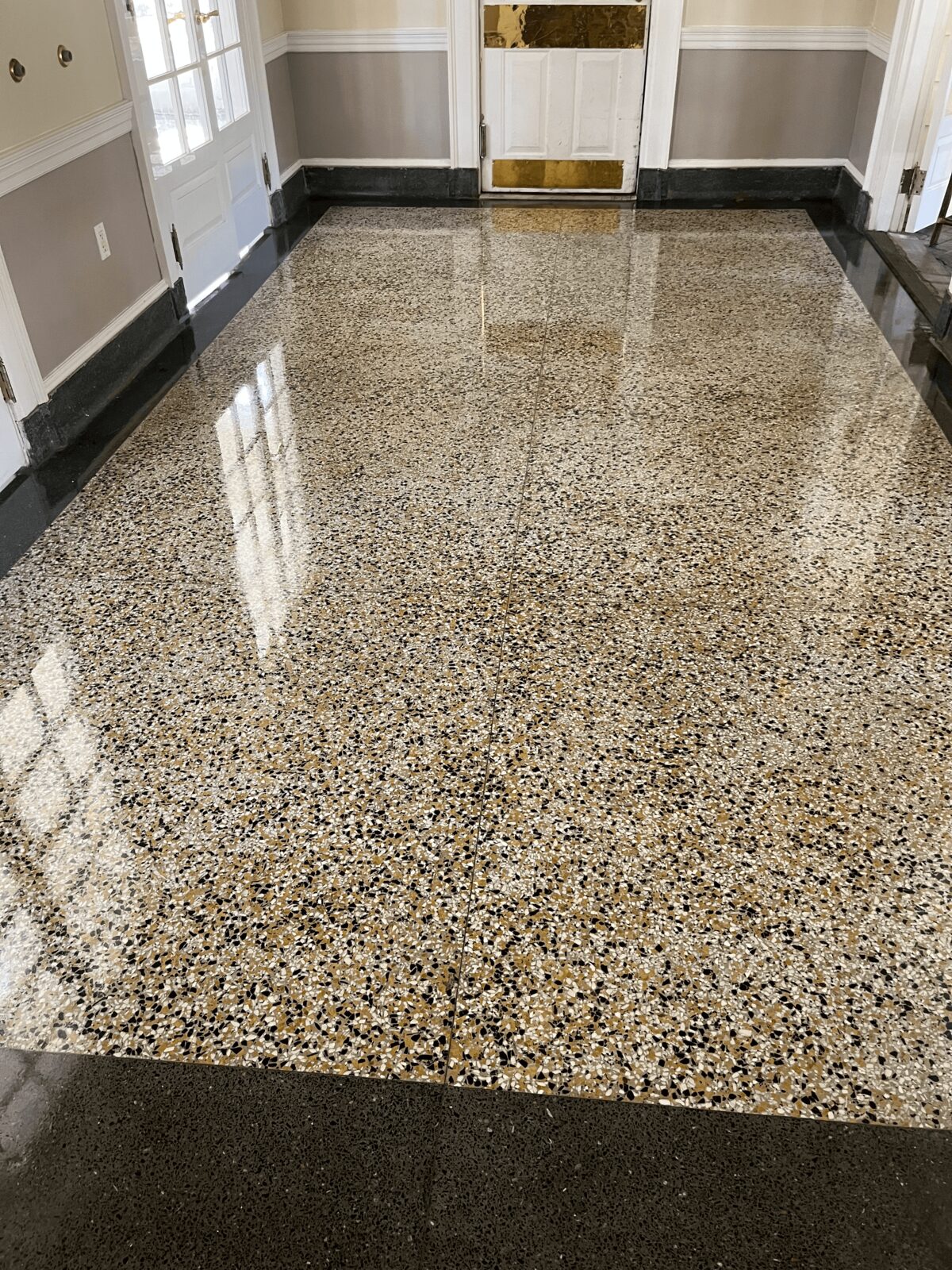
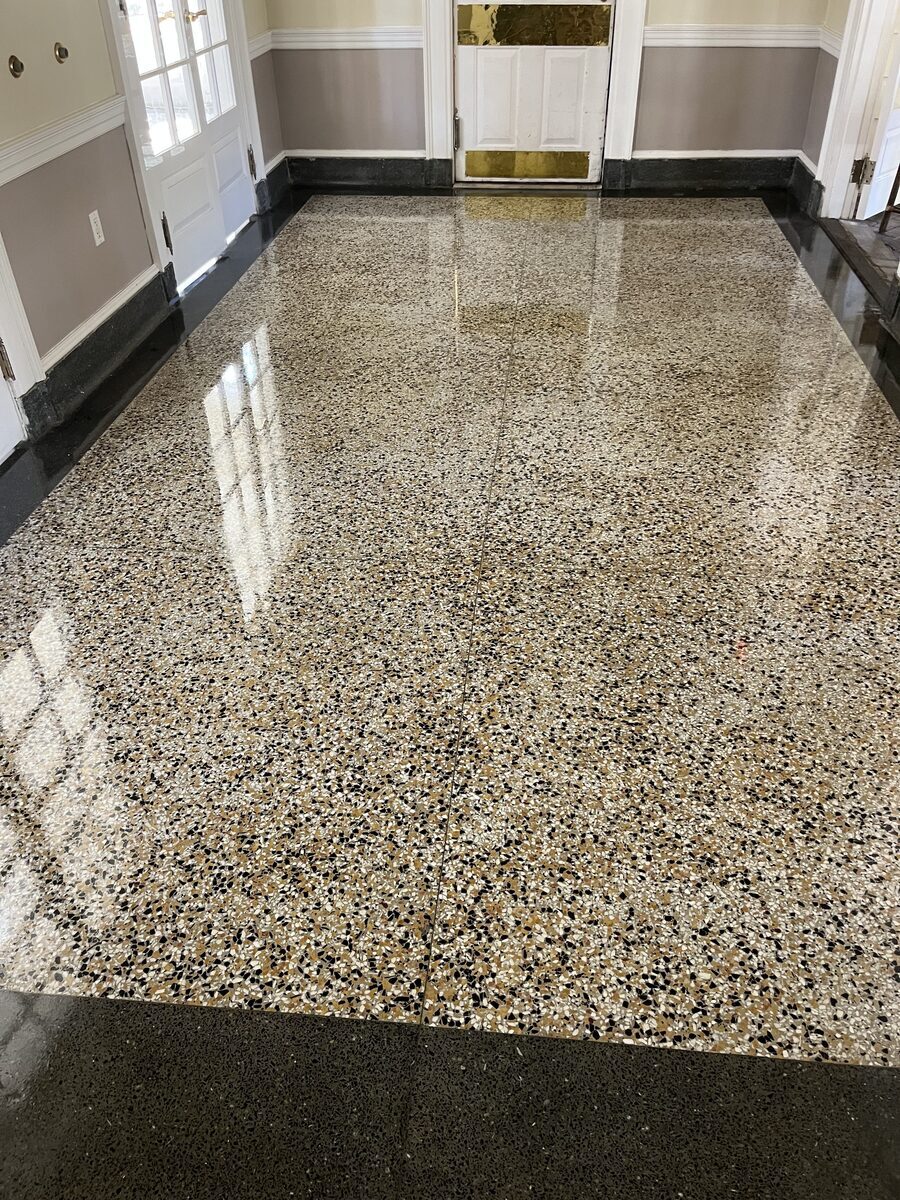
Terrazzo shows up all over Northeast Florida in buildings from the 1950s through the 1970s — downtown government inventory, older school campuses, church narthexes, several San Marco and Riverside commercial buildings, and a lot of St. Johns County public facilities. In many of them it has been buried under twenty or thirty years of acrylic finish because a succession of janitorial vendors treated it like VCT.
Polished terrazzo does not need wax. Its gloss comes from mechanical refinement: progressive diamond honing that starts around a 50 to 120 grit cut to flatten the surface and expose fresh aggregate, then steps through 200, 400, 800, 1500 and 3000 grit, followed by a lithium silicate densifier that chemically hardens the matrix and an impregnating sealer that repels stains without forming a surface film. The result is the stone itself reflecting light, not a coating sitting on top of it.
That matters economically. A terrazzo restoration runs a real number up front. National restoration pricing for commercial lobbies, schools and government spaces currently spans roughly $5 to $18 per square foot depending on damage and repair scope, though straightforward Jacksonville commercial work with intact matrix typically lands at the lower end. After that, annual maintenance polishing is cheap, there is no annual strip cycle, no yellowing, and no slip variability from a worn wax layer. Over a ten-year horizon it usually beats waxing on total cost, and it looks dramatically better. For a government or institutional building where the terrazzo is original to the structure, it is also the preservation-correct answer.
The Humidity Problem That Is Specific to This Coast
Floor finish cures by water evaporation and coalescence of polymer particles. Push ambient relative humidity above roughly 70 percent and evaporation slows enough that coats stay tacky, fail to level, or trap moisture between layers and dry cloudy.
Jacksonville sits above that threshold for most of June through September. The complication is that the buildings we work in are usually empty at night with the HVAC set back to save energy, so a corridor that reads 55 percent relative humidity at 3 PM can read 82 percent at 11 PM when the crew is laying the third coat. The finish did not fail. The building did.
The fix is scheduling and coordination, not a different product. HVAC stays in occupied mode through the refinish window and for several hours after the last coat. Portable dehumidification gets staged in enclosed corridors and windowless interior spaces. Dry time between coats stretches from the label's 30 minutes out to 45 or 60. Full cure before burnishing runs 24 to 72 hours, and putting a 2,000 RPM burnisher on a floor that has cured for eight hours will pull the finish right back off.
The pattern we see across the Southside and Baymeadows corridor is that a property manager schedules a strip-and-wax for a holiday weekend, the building engineering staff is also off for that weekend, and the HVAC runs on the holiday schedule. Every refinish job in a Florida summer needs the building engineer looped in before the date is set. That conversation takes ten minutes and prevents a redo.
Need a floor program scoped against your actual substrates?
System4 of North Florida runs commercial floor care across Jacksonville, Saint Augustine, Ponte Vedra, Orange Park, Mandarin and the Beaches. We walk the building, identify every substrate by type, pull manufacturer maintenance specs where they exist, and build a strip, recoat and burnish calendar around your access windows. Locally owned, headquartered in Saint Augustine, SDVOSB-certified with an active SAM.gov registration under NAICS 561720.
See our commercial floor care services or call (904) 906-6400 to schedule a walkthrough.
Slip Resistance: The Standard Your Carrier Cares About
Floor finish selection is a liability decision as much as an appearance decision. The relevant benchmark is ANSI A326.3, which sets dynamic coefficient of friction (DCOF) thresholds measured with a BOT-3000E tribometer. The 2022 revision established a five-category product use classification and set a minimum DCOF of 0.42 for level interior surfaces expected to be walked on when wet, with 0.50 for ramps and areas routinely exposed to water.
Separately, OSHA 29 CFR 1910.22 requires that walking-working surfaces be kept clean, orderly, dry where possible, and free of hazards, and that hazardous conditions be corrected or guarded before employees use the surface again. That standard is why wet-floor signage placement and crew re-entry protocol belong in the scope of work, not in the crew's discretion.
Practically, this means a high-gloss finish is not automatically the right finish. A building lobby that takes in rain nine months a year, a commercial kitchen approach corridor, a gym entry — these want a finish selected for DCOF performance and adequate walk-off matting, not maximum shine. If you run a facility with a wet-entry problem, our notes on commercial kitchen cleaning in Jacksonville cover the grease-plus-water interaction that makes those corridors the highest-claim area in most buildings.
UV-Cured Finish: Worth It, and When It Is Not
UV-cured floor coatings are applied wet and then instantly cross-linked with a UV lamp rolled across the floor. The coating is hard within minutes, the space is walkable immediately, and the service life runs five to seven years with no annual strip cycle.
The upfront cost is several times a traditional refinish, and the removal process, when it eventually comes, requires mechanical abrasion rather than chemical stripping. That makes it a strong fit for a hospital corridor, a 24-hour operation that cannot surrender a floor for a two-day cure, or a school gym floor perimeter. It makes it a poor fit for a tenant space with a three-year lease and an uncertain renewal, where nobody will be around to capture the back half of the payback.
This is not the right service for a 3,000-square-foot suite with a single VCT corridor. Conventional strip and refinish, done correctly on an honest schedule, is the better economics at that size. We will say so during the walkthrough.
What Commercial Floor Care Costs in the Jacksonville Market
Published pricing is rare in this trade, which is exactly why bids are so hard to compare. These are the ranges we see across Northeast Florida as of mid-2026. Use them to interrogate a quote, not as a substitute for a measured walkthrough.
| Service | Jacksonville Range (per sq ft) | What Moves the Number |
|---|---|---|
| VCT strip and refinish (4–5 coats) | $0.35 – $0.75 | Furniture density, layer buildup, edge detail, after-hours access |
| Scrub and recoat (1–2 coats) | $0.18 – $0.35 | Coat count, open floor versus partitioned |
| Burnishing (per pass) | $0.05 – $0.12 | Frequency commitment, equipment staging |
| LVT deep scrub (no finish) | $0.12 – $0.25 | Soil load, texture depth of the wear layer |
| Terrazzo diamond restoration (initial) | $2.50 – $6.00 | Wax removal depth, crack and chip repair, matrix condition |
| Terrazzo maintenance polish (annual) | $0.40 – $0.90 | Traffic volume, sealer condition |
| Concrete densify and guard | $1.50 – $4.00 | Slab condition, gloss level specified |
| UV-cured finish application | $1.75 – $3.50 | Substrate prep required, coverage area, lamp staging |
A bid materially below these ranges is usually funding the discount out of coat count, a skipped neutralizing rinse, or an uninsured subcontractor holding the machine. A bid materially above them should come itemized. Sometimes the premium is real — heavy furniture moving, terrazzo repair, a compressed overnight window — and sometimes it is padding you can negotiate out once you know what to ask.
The Five-Question Floor Audit
Before you approve the next floor care line item, put these five questions to whoever holds the contract. They take about ten minutes and they surface most of the problems in this trade.
1. What substrate is each area, and where did that determination come from? The answer should reference a manufacturer maintenance sheet or a physical inspection, not an assumption. LVT mistaken for VCT is a five-figure error.
2. When was this floor last fully stripped, and what is the current layer count? If nobody knows, that itself is the answer, and the baseboard edge will confirm it.
3. Is a neutralizing rinse with pH verification included in the strip scope? Get it in writing. It is the first thing cut on a lowball bid.
4. What is the HVAC and dehumidification plan for the refinish window? In Florida, between June and September, this question separates crews who have done this here from crews who have not.
5. What DCOF does the specified finish achieve, and does it meet ANSI A326.3 for the wet areas in this building? Your carrier will eventually ask. Better to have the answer before the claim.
How This Fits a Broader Facility Program
Floor care rarely stands alone. It sits inside a building-wide program along with nightly commercial cleaning in Jacksonville, day porter coverage, and periodic deep work. The scheduling matters as much as the technique: strip cycles have to be sequenced around tenant move-ins, exam schedules, semester breaks, and lease turnovers.
For multi-tenant office buildings and community asset managers, the floor program is usually the most visible line item on the common-area budget, which makes it the first thing a tenant points at during a complaint. Our Village Square facility management case study walks through how a multi-building common-area program gets sequenced without disrupting tenants.
For federal, state and municipal facilities, floor care scope often lands inside a broader custodial contract with specific finish and slip-resistance requirements written into the solicitation. System4 of North Florida holds SDVOSB and VOSB status with an active SAM.gov registration, and our government and federal contracting page covers how we structure those responses. Buildings with original terrazzo are common in that inventory, and the restoration-versus-wax conversation usually saves the agency money.
Most refinish work happens on after-hours schedules in Jacksonville, and for schools and campuses the summer window is the whole ballgame — see our notes on school cleaning in Jacksonville for how those calendars get built. New builds and tenant fit-outs come with their own floor sequencing problem, covered in our post-construction cleaning guide. Crews dispatch across the Jacksonville service area from our Saint Augustine base.
About the Author
Weston "Wes" Henderson — Owner and Founder, System4 of North Florida (KLH Management Group LLC)
United States Navy veteran. Founded System4 of North Florida in 2017 and has run commercial floor care and janitorial programs across Baymeadows, Southside, San Marco, Riverside, Mandarin, Westside and the Beaches submarkets of Jacksonville since. Service-Disabled Veteran-Owned Small Business (SDVOSB), Veteran-Owned Business (VOSB), Minority-Owned Business, self-certified Small Disadvantaged Business, FEMA Disaster Response Registry. Active SAM.gov registration, primary NAICS 561720. MicroShield 360 certified. Rated 4.9 stars Google-rated.
701 Market Street, Ste 111, Saint Augustine, FL 32095. Reach Wes directly at (904) 906-6400 or through the contact form.
Frequently Asked Questions
Most Jacksonville commercial VCT floors need a full strip and refinish every 12 to 24 months, with two to four scrub-and-recoat cycles in between. The interval depends on traffic volume, whether the building has adequate walk-off matting at entries, and whether the floor is being burnished on a regular schedule. A 40,000-square-foot Southside corporate office with good matting and monthly burnishing can often stretch to 24 months. A Westside light-industrial breakroom with forklift traffic tracking in grit may need stripping every 9 to 12 months. Stripping more often than necessary is wasteful and slowly wears the tile; stripping less often than necessary produces the yellow edge buildup and gray traffic lanes that no amount of recoating will fix.
Scrub-and-recoat removes only the top one or two worn layers of floor finish using a lower-alkalinity cleaner and a blue or green pad, then applies one to two fresh coats. It typically takes a third of the labor of a full strip and costs roughly half. Strip-and-refinish chemically dissolves every layer of finish down to bare tile using a high-alkalinity stripper, requires a neutralizing rinse to bring the floor back to a neutral pH, and rebuilds the finish with four to five thin coats. Recoating is the maintenance operation. Stripping is the reset. A well-run program uses recoats to defer strips for as long as the floor honestly allows.
In most cases, no. The majority of commercial LVT installed in the last decade ships with a factory-applied UV-cured urethane wear layer that is harder and more chemically resistant than any floor finish applied in the field. Stripping that wear layer with a high-pH stripper damages it permanently, and once damaged the floor requires ongoing finish application forever to look acceptable. This is one of the most expensive mistakes a facility manager can inherit from a cleaning vendor who treats every hard floor the same way. Confirm the wear layer with the manufacturer's maintenance sheet before anyone brings a stripper into the building.
Terrazzo can be waxed, but on most commercial installations it should not be. Polished terrazzo achieves its gloss mechanically through progressive diamond honing, typically running from a 50 to 120 grit cut through 200, 400, 800, 1500 and 3000 grit refinement, followed by a lithium silicate densifier and an impregnating sealer. That finish is the stone itself, not a coating, so it does not yellow, does not require an annual strip, and does not create the slip variability that a worn wax layer does. Many older Jacksonville buildings, including several downtown and in the government inventory, have terrazzo buried under decades of accumulated wax. Removing the wax and polishing the terrazzo underneath is usually the better long-term economic decision.
Floor finish cures by water evaporation and coalescence of the polymer particles. When ambient relative humidity climbs above roughly 70 percent, evaporation slows sharply, coats stay tacky, and the finish either fails to level or traps moisture between layers, which produces a cloudy or milky appearance. Jacksonville routinely runs above that threshold from June through September, and a building with the HVAC set back overnight to save energy can sit at 75 to 85 percent relative humidity during exactly the hours a floor crew is working. The fix is coordination rather than chemistry: HVAC stays in occupied mode through the refinish, portable dehumidification gets staged in enclosed corridors, and dry time between coats extends from the label's 30 minutes to 45 or 60.
Strip-and-refinish on commercial VCT in the Jacksonville market runs roughly $0.35 to $0.75 per square foot, with the spread driven by furniture density, layer buildup, edge and corner detail work, and after-hours access constraints. Scrub-and-recoat runs roughly $0.18 to $0.35 per square foot. Burnishing runs $0.05 to $0.12 per pass. Terrazzo diamond restoration is a different category entirely at roughly $2.50 to $6.00 per square foot for the initial grind and polish, with maintenance polishing after that at $0.40 to $0.90. Bids materially below these ranges usually signal thin finish coats, a skipped neutralizing rinse, or an uninsured subcontractor. Call (904) 906-6400 for a walkthrough and a measured quote.
Sources & Further Reading
- OSHA — 29 CFR 1910.22, Walking-Working Surfaces, General Requirements
- OSHA — Walking-Working Surfaces and Personal Fall Protection Systems Final Rule FAQ
- Tile Council of North America — Dynamic Coefficient of Friction and ANSI A326.3 (2022 revision, five-category product use classification)
- Tile Council of North America — ANSI A326.3 Product Use Classification Requirements for Hard Surface Flooring
- National Floor Safety Institute — ANSI/NFSI B101 walkway slip-resistance standards and auditing guidance
- ISSA — Cleaning Times, hard floor care standards, and CIMS certification criteria
- National Terrazzo & Mosaic Association — terrazzo maintenance and restoration guidance
- NFPA 253 — Standard Method of Test for Critical Radiant Flux of Floor Covering Systems
- EPA Safer Choice — certified cleaning and floor care product criteria
- Cleaning & Maintenance Management — Rethinking VCT Floor Maintenance
Related Services for Jacksonville Facilities
Floor care sits inside a broader facility program. Related services across Northeast Florida: